The following article is provided compliments of the DA Scene, a publication of the Department of the Army. “Fit to fight” is what the Army’s new Physical Readiness Test (APRT) is all about.
There will be one test for male and female soldiers in all types of assignments. The test includes sit-ups, pushups, and the two-mile run. At the start 1 of this new test, soldiers over 40 will only have to run the two-mile event, but this may change in a year to include the other two events.
Sit-up and push-up tests will have a two-minute time limit. Previously, men had a one-minute time limit and women had no time limit.
The standards for sit-ups and pushups will be tougher but the push-ups will be done differently under the new program. The push-ups will still be started from the “front leaning rest” position. The soldier will lower his or her body, bending the elbows until the top of the upper arms, shoulders and lower back are straight and parallel to the ground. It is no longer necessary for the chest to touch the ground. When the soldier’s body returns to the front leaning position rest position with the elbows locked, it will be counted as one pushup. Men and women will do push-ups the same way.
Sit-ups for both men and women will be done with the knees bent at 90-degree angles and feet held to the ground by another soldier. Fingers will be joined behind the head. However, there is no requirement to touch elbows and shoulders to the ground. Only the hands and back have to touch the ground.
Two-mile run times are faster for most age groups but there are no other changes in the running event.
In order to pass the new APRT, all soldiers except those in basic training must score at least 60 points in each event and have a total score of 180 points.
Soldiers in basic training must get at least 40 points in each event and have a total score of 160 points to pass. In order to reach the goal of 160 points, a soldier in basic training must score more than 50 points in at least one event to pass the overall test.
All soldiers will be tested twice a year under the three-event APRT with at least four months between each test. Soldiers over 40 will have some different rules. Medical clearance must be given by an Army doctor before a soldier can take part in the over-40 APRT program. Once the soldier has been cleared, a six-month conditioning program must be completed before the two-mile run test will be given.
Army training officials said the new APRT manual was expected to be published in January 1981. It will contain details of the overall program. After November 30, 1980, the new APRT can be given to soldiers for record.
Scoring table
This is the table of scoring standards that will be used in the new Army Physical Readiness Test program. The first figure shown in each column is the minimum number needed to pass the test. The second figure is the number needed to score the maximum 100 points in each event.
MEN UNDER 40
Age
Push-ups
Sit-ups
Two-mile run
17-25
40 / 68
40 / 69
17:55 / 13:05
26-30
38 / 66
38 / 67
18:30 / 13:40
31-35
33 / 61
36 / 65
19:10 / 14:20
36-39
32 / 60
34 / 63
19:35 / 15:05
WOMEN UNDER 40
Age
Push-ups
Sit-ups
Two-mile run
17-25
16 / 40
27 / 61
22:14 / 17:10
26-30
15 / 38
25 / 51
22:29 / 17:25
31-35
14 / 34
23 / 41
24:04 / 19:00
36-39
13 / 30
21 / 31
25:34 / 20:30
SOLDIERS OVER 40
Soldiers over 40 will only be tested in the two-mile run. They will be graded on a go / no-go basis. The standards are as follows
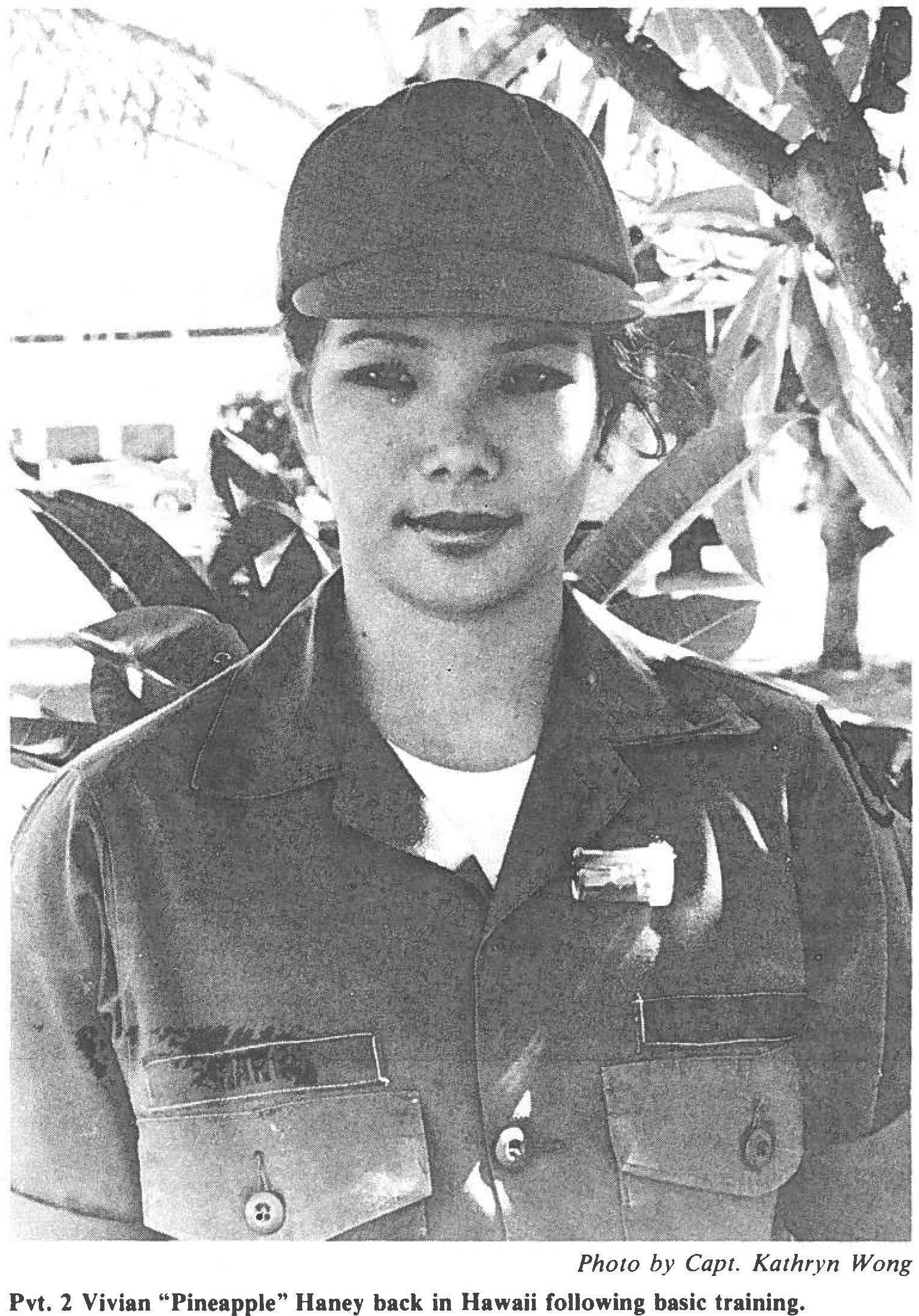
As told by: Vivian “Pineapple” Haney From hula-maiden to olive-drab green
Editors note: Vivian Haney, 18, recently returned to Hawaii following basic training at Fort Jackson, South Carolina. Of Korean-Irish-Italian descent, she works for Greeters of Hawaii and enjoys dancing, roller skating, and going to the beach in her free time. Raised an “Army brat,” she has lived in Hawaii for 1O years with her family in Mililani.
Pvt. 2 Vivian “Pineapple” Haney back in Hawaii following basic training. (Picture from the 1981 Winter Pupukahi)
What follows is her personal account of basic training:
When I joined the National Guard, my recruiter, Sgt. 1st Class Eddie Llanos, never promised me the world; he made every effort to present all aspects of the Army, the bad as well as the good.
Sergeant Llanos asked me several times if I really wanted to join. At the time, it was all I wanted. I passed the tests and took my oath. Before leaving, I had the opportunity to attend two drills t my future unit. I met lots of nice people of all ranks.
So, I thought to myself, “This can’t be too bad.”
Was I in for a big surprise! I had been told time and time again to go to basic training thinking, “This is just a game. Stick it out and everything will be okay.”
It took two days to reach Fort Jackson, arriving at the reception station on a cold Saturday morning. It was 14° and I was certain I’d die. I suffered from jetlag, hunger, and was just plain miserable. I’d never been away from my family. I’d always had someone near me and now I was alone and on my own.
Since it was Saturday, it took extra long to in-process because most of the staff had weekends off. I remember sitting in a big room full of strangers, feeling so alone and afraid. Finally, after two or three hours of waiting, we were led to our company barracks.
We got our linen and were assigned bunks. There were already 35 girls there who had arrived the previous night. I put away my belongings, sat on my bunk, looked at all the different faces, and started to cry.
Fifteen minutes later we were called to chow. The chow line was so long, it took an hour before I entered the mess hall and another 30 or 40 minutes to get my food. But I had no appetite. I didn’t eat at all for the next three days.
Processing on Monday was followed by the issuing of uniforms on Thursday, which took all day. After finishing that, the next day we had our name tags and insignia sewn on our fatigues and in the afternoon we got our immunizations.
I’ve always hated needles and was terrified. When I began to cry (I do that pretty well.), the medical technician said to me, “Shut up before I shoot you in the nose!”
I was so angry at her. Of course, I didn’t realize that she had to cope with thousands just like me. I had more shots, then we had a 20-minute rest period. I was crying real hard.
That’s when I got my first look at my tough drill sergeant. He walked around the room and just laughed and told us he hated female trainees and was going to run us into the ground. I was afraid to look at him.
After a terrifying ride to our new barracks aboard an Army truck, we filled out more forms and got the supplies and books we would be needing for basic training.
We then had to run to our barracks with our belongings. I had a duffle bag, suitcase, and another bag. After making two trips to finally get everything together, I entered the barracks.
What a mess! Dust covered everything.
By this time, the shots were beginning to take effect and I felt so sick. I thought that I had come down with something awful but the drill sergeant told us that if we felt sick, it was just temporary from the shots. He briefed us on what to expect, then told us to fall out for chow.
That meant running in formation. I was weak but managed to jump over a duffle bag to get out with everyone else: Somehow, I also managed to run almost head on into the drill sergeant.
He yelled at me and made me stand at parade rest and keep an eye on all the baggage while everyone else ate. When he finally left, I started to cry once again.
By now I was a real professional at crying and considered making it my military occupational specialty. I stood there for 20 minutes before someone finally came to get me. The food didn’t look good because I was sick. To make it worse, it tasted awful.
In basic training, you’re supposed to run everywhere you go. I didn’t know that so after chow I walked to my formation-and my sergeant yelled at me again. This time he made me do pushups. That came as a big shock to me. I left home never having done any. Believe me, you can do anything under pressure, I did two to the best of my ability.
He let me get up and told me that from now on he was going to keep an eye on me.
Slowly, l picked up the name, “Pineapple.” That was my Army name from then until the end of basic.
For a while, I tried to get a trainee’s discharge. For some reason I just couldn’t seem to convince the first sergeant that I was a failure. He was more sure of me than I thought l could ever be.
After a long lecture from the company’s sergeant major, I decided to stick it out and make each day count. It was hard, very hard.
The first thing that we learned was drill and ceremonies and facing movements. I enjoyed that. I also enjoyed learning the different songs that we sang to cadence.
We were issued our very own buddy, not the human kind but an M-16. I was pretty excited to be carrying around an M-16 and couldn’t wait to learn how to operate it.
Next, we began classroom training which consisted of first aid, guard duty, the Geneva Convention, and so forth. It was very difficult to stay awake sometimes but l knew that these classes were important so I took notes and tried hard to keep awake.
Then we learned to assemble and disassemble our weapons. Besides classroom instruction, we had two-hour bleacher instructions, which meant sitting on cold bleachers and learning all kinds of things like range safety. It was miserably cold and I thought I would catch the flu.
Several days later, our company was to experience what I thought was the worst thing in basic training: the gas chamber.
It was a nightmare to me because l stayed in there for about three minutes without a mask. Entering the chamber with our protective masks and steel helmets, we were asked to take off the helmets. Then we were asked to take our masks off, stand still, then execute an about face. l could see that people were suffering from the burning gas.
The sergeant approached me and yelled, “What the hell is wrong with you, soldier?”
I just barely answered him, choking back the tears, and told him that I did not really want to do this. He then made our squad take off our masks. I tried to leave with the first five to be dismissed but was too slow. I felt a burning in my chest and all over my face and hands.
After about three minutes, l got sick. l recovered after 10 minutes and stood at the top of a hill and watched the others. l knew what it was like and told myself that I would never go back in there ever again.
Next came the crucial part of basic training, surviving in the fields. This is what the Army calls bivouac. We arrived at the site and unloaded the bivouac gear, including tents, gas suits, shovels, sleeping bags, and so forth.
We had to put our tents up while wearing our gas suits and masks. We then dug trenches around our tents in case of rain.
After that was completed, we had the famous P.T. That was something we did every day, regardless of the weather. During basic training we ran two or two-and-a-half miles a day. During bivouac it got worse. We had to run in the woods, with sand hills and leave everywhere.
Finished with our first session of P.T. we got ready to go on the march to a day-night defense range. It was very cold so we had to bring our field jackets and liners but unfortunately I left mine behind.
The whole day was spent preparing for the night exercises. Then came the big surprise. The chow that we had been so hungry for turned out to be a nightmare C-rations. I settled for the fruits.
Then it was time to return to the company, but this time not in the trucks that we were so used to riding. We had to march back! We had already completed the 7- and 10-mile marches and this was to be the final one a lot of us were not anxious to do.
It was late afternoon and we were on our way. Single file and 15 meters apart, we marched carrying our weapons and wearing backpacks which consisted of our bivouac equipment.
The biggest mistake I made was drinking lots of juice. After a few hours of marching, it began to take effect. I could hardly stand it, marching and having to go to the bathroom so badly. Finally, after what seemed to be an eternity, we stopped for a break and this was the only opportunity to go to the bathroom, in ‘the woods’.
Marching on and on, I thought that we had almost reached our destination when I saw the rifle ranges and knew that we had further to go .. As we marched along we knew that we were getting close to what we called home, and it certainly was, after bivouac
We knew there was one more tough part to complete and that was a hill. I used all my remaining energy to reach the top of the hill and when we did, a couple of us yelled out, “We made it!” That must have been the happiest time of the entire experience.
Graduation day had been our main goal. Our whole company had looked forward to that day so distant it seemed it would never come. After eight weeks of hard, physical training, it arrived.
I remember it so clearly. It was a cold morning and I thought it would snow. Four of us were chosen to clean the day room and we were all talking a bout how soon we’d see home again; what a good feeling that was.
At 7:30 a.m. we all marched two miles to the theatre looking sharper than we ever thought we could look. The ceremonies were brief and awards given to outstanding recruits. We marched the two miles back, then it was really over.
Some of the more fortunate people had family come see them.
I called home and told my family that it would be another five or six weeks before I returned home. We said our good-byes, exchanged addresses, and went our separate ways.
Basic training was over and I was so glad. It had been the most difficult experience of my life, but also the most rewarding.
Thinking back to the beginning when I’d wanted to get a discharge and go home, I was embarrassed and so glad I hadn’t left. I’d have been a loser and worse than that, I’d have missed the opportunity to grow up and be more proud of myself.
One of the most important discoveries was what I learned about my family and what they meant to me. I missed my family so much. At home I had always wanted to be left alone, to think for myself, and not have anyone on my back.
The longer I was away from home, the more I realized that I had taken the love, care, and attention at home for something other than the fact that these people, my family, cared for me and I hadn’t ever really appreciated it. That thought stayed with me from day one at Fort Jackson until I returned to Hawaii.
Since my return I’ve tried to get friends to join the National Guard and experience what I have. Sure, basic training was awful at times but what I got out of it, the pride and self-confidence and maturity, was worth every minute of it!
EIN Presswire provides this news content "as is" without warranty of any kind. We do not accept any responsibility or liability
for the accuracy, content, images, videos, licenses, completeness, legality, or reliability of the information contained in this
article. If you have any complaints or copyright issues related to this article, kindly contact the author above.