

Global Biodegradable Packaging Market to Reach USD 24.2 Billion by 2036 as Sustainability Drives Adoption
Biodegradable Packaging Market Forecast 2026–2036: Global Market to Expand at 6.1% CAGR Driven by Circular Economy Policies and Compostable Innovation
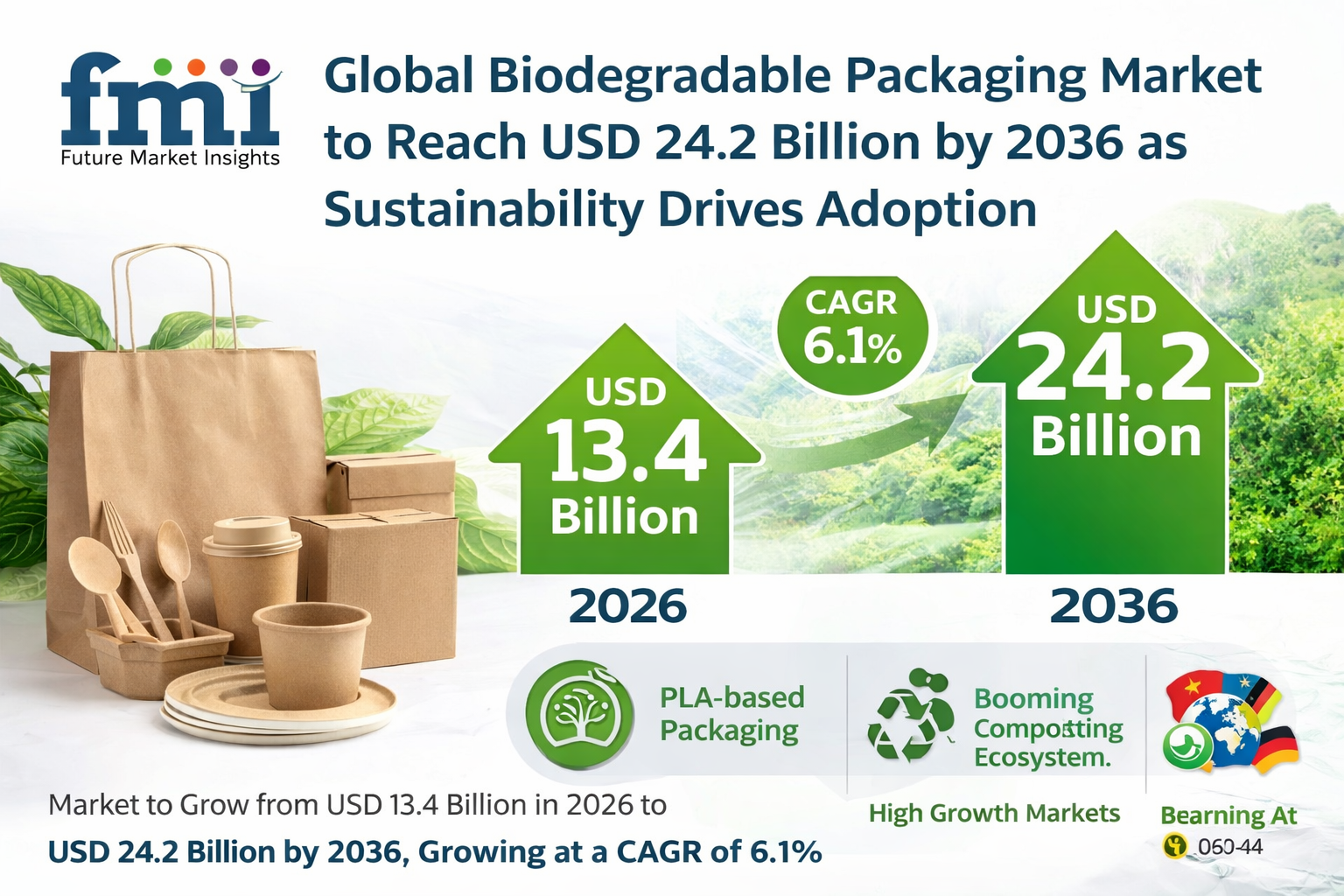
NEWARK , DE, UNITED STATES, March 26, 2026 /EINPresswire.com/ -- The global biodegradable packaging market is entering a decisive growth phase, projected to rise from USD 13.4 billion in 2026 to USD 24.2 billion by 2036. This expansion, at a steady CAGR of 6.1%, reflects a structural shift in how industries approach packaging moving beyond sustainability rhetoric toward measurable, compliant, and scalable material solutions.
What distinguishes this growth cycle is not just regulatory pressure, but a convergence of consumer behavior, infrastructure readiness, and material science innovation. Decision-makers across food service, retail, and logistics are increasingly prioritizing packaging systems that align with compostability standards while maintaining operational efficiency.
Quick Stats of Biodegradable Packaging Market
• Market Size (2026): USD 13.4 Billion
• Forecast Value (2036): USD 24.2 Billion
• CAGR (2026–2036): 6.1%
• Leading Material: PLA-based packaging (41%)
• Leading Application: Food Packaging (40.0%)
• Leading Functionality: Home Compostable (42.0%)
• High-Growth Markets: China, India, Germany
Market Perspective: From Sustainability Promise to Procurement Reality
The biodegradable packaging sector is no longer driven by brand positioning alone. Instead, it is being shaped by enforceable policies, supply chain recalibration, and measurable ROI on sustainability investments.
Across global markets, procurement teams are transitioning toward certified compostable materials not as an optional upgrade, but as a compliance requirement. This shift is particularly evident in food packaging, where contamination of recyclable waste streams has made compostable alternatives a practical necessity.
At the same time, consumers are demonstrating a clear willingness to pay a 20–25% premium for environmentally responsible packaging, reinforcing the commercial viability of biodegradable solutions despite higher production costs.
Get Access of Research Report Sample: https://www.futuremarketinsights.com/reports/sample/rep-gb-323
Key Growth Drivers Shaping Industry Transformation
Regulatory Acceleration Across Global Markets
Governments are implementing strict bans and recycled material mandates, forcing manufacturers to adopt biodegradable alternatives. Compliance is rapidly becoming a market entry requirement rather than a competitive advantage.
Consumer-Led Demand for Eco-Friendly Packaging
End users are actively influencing packaging strategies:
• Preference for compostable products
• Increased awareness of plastic waste impact
• Strong alignment with ESG-focused brands
Expansion of Composting Ecosystems
The viability of biodegradable packaging is improving due to:
• ~15% annual growth in industrial composting facilities
• Better organic waste collection systems
• Integration of composting into municipal infrastructure
Technology & Innovation Trends Redefining the Market
PLA Dominance with Evolving Capabilities
Polylactic Acid (PLA)-based packaging leads due to its PET-like clarity, scalability, and production compatibility, while advancements in Crystallized Polylactic Acid (CPLA) are expanding its use in hot food and beverage applications requiring higher thermal resistance.
Rise of Home Compostable Solutions
With limited industrial composting access in many regions, home-compostable materials are gaining traction, with Polyhydroxyalkanoates (PHA) and starch-based blends preferred for their ability to break down naturally, while evolving certification standards continue to influence purchasing decisions and build consumer trust.
Barrier & Performance Enhancements
Material innovation is overcoming traditional limitations in biodegradable packaging through improved moisture and oxygen resistance, multi-layer biodegradable laminates, and the use of nano-cellulose to enhance strength and barrier performance.
Operational Realities: What Industry Leaders Are Solving
Despite strong growth momentum, the transition to biodegradable materials introduces new operational considerations:
• Shorter material shelf life requires strict inventory control
• Processing adjustments needed for PLA vs conventional plastics
• Higher production cycle times impact throughput efficiency
• Feedstock price volatility affects EBITDA margins
Forward-looking companies are mitigating these challenges through:
• Vertical integration
• Long-term feedstock contracts
• Investment in fermentation technologies
Regional Outlook: Where Growth Is Concentrated
Asia Pacific Leads Expansion
China and India are emerging as dominant growth engines, driven by aggressive plastic bans, rapidly expanding retail and food delivery sectors, and strong government support for bio-based materials.
Europe: Regulation-Driven Stability
Markets such as Germany are benefiting from a strong recycling culture, advanced certification systems, and close alignment with EU Green Deal objectives, which collectively support sustained growth in environmentally responsible packaging solutions.
North America: Infrastructure Meets Innovation
The United States continues to lead in biopolymer innovation, expanding composting adoption across urban centers, and strengthening corporate sustainability commitments, positioning it at the forefront of advanced biodegradable packaging development.
Competitive Landscape: Innovation as a Differentiator
The market is characterized by strategic consolidation and technology-driven competition.
Leading players such as NatureWorks, BASF, and Novamont are:
Companies are expanding polymer capacity, investing in Polyhydroxyalkanoates (PHA) and cellulose-based materials, and acquiring biotech startups to access proprietary technologies. A key differentiator is the ability to offer certified, scalable, and performance-ready biodegradable solutions rather than niche alternatives.
Future Outlook: A Structural Shift Toward Bio-Based Packaging
The next decade will define biodegradable packaging as a mainstream industrial standard rather than a niche category.
Key developments expected:
Future growth will focus on achieving cost parity, scaling agri-waste and algae feedstocks, enabling QR-based disposal guidance, and aligning with circular economy frameworks.
Frequently Asked Questions
What is the size of the biodegradable packaging market in 2026?
The market is valued at USD 13.4 billion in 2026.
What is the forecast value by 2036?
It is projected to reach USD 24.2 billion.
What is driving market growth?
Regulations, consumer demand, and composting infrastructure expansion.
Which material leads the market?
PLA-based packaging with a 41% share.
Which sector drives the most demand?
Food packaging, accounting for 40% of the market.
Related Reports
• Biodegradable Plastics Market
https://www.factmr.com/report/biodegradable-plastics-market
• Biodegradable Packaging Market Share Analysis
https://www.futuremarketinsights.com/reports/biodegradable-packaging-market-share-analysis
• Biodegradable Food Packaging Market
https://www.futuremarketinsights.com/reports/biodegradable-food-packaging-market
About Future Market Insights (FMI)
Future Market Insights (FMI) is a globally recognized market research and consulting firm, delivering data-driven insights across industries. With a strong focus on actionable intelligence, FMI supports organizations in navigating complex market transitions and identifying growth opportunities.
Why FMI: https://www.futuremarketinsights.com/why-fmi
Sudip Saha
Future Market Insights Inc.
+1 347-918-3531
rahul.singh@futuremarketinsights.com
Legal Disclaimer:
EIN Presswire provides this news content "as is" without warranty of any kind. We do not accept any responsibility or liability for the accuracy, content, images, videos, licenses, completeness, legality, or reliability of the information contained in this article. If you have any complaints or copyright issues related to this article, kindly contact the author above.
